As spring and summer approaches, many horses’ activity levels increase. Whether this is in preparation for competitions, or for leisurely riding, it’s important to understand how increased activity levels affect the hooves, and what the owner can do to support their barefoot horse.

Increasing activity levels requires patience
As the workload is upped, the stressors on the hooves also increase. If your barefoot horse has spent the winter months on soft surfaces, such as in snow or mud, it’s not advisable to expose the hooves to hard surfaces all of a sudden. Although movement is beneficial to hooves in general, any sudden changes can cause pain or damage.
The best way is to increase work in stages. If the living environment already has varying surfaces – for example on a track system or in active stabling – the adjustment is much smoother and easier. But if the exercise happens on surfaces that are very different from where the horse lives, additional hoof protection in the form of hoof boots is required.
Why are hoof boots barefoot horse’s best friend?
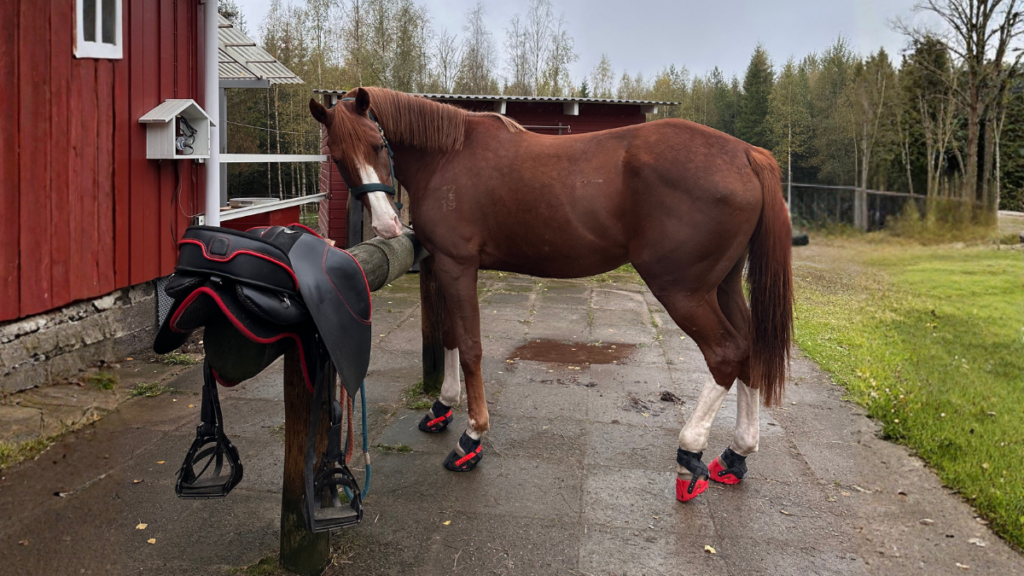
Good hoof boots are ones that protect the hoof from impact and excessive wear, but still allow the hoof to function as nature intended. They do not only protect, they also enable the horse to feel the ground underneath their hooves, and give good traction.
Many owners wonder if their horse fails to stay barefoot, if they need boots for exercise. We can assure you that this is definitely not the case. You need to remember that the hard, stont ground is always harder than the horse’s hoof. Therefore, it makes sense to protect the hoof when it’s on terrain that is too demanding for it. Even wild horses experience hoof problems on hard surfaces – and we are asking the domesticated horse to carry our weight on top of their own.
Watch out for these warning signs
The first signs of pain in the hooves are somewhat subtle: the horse might seem slightly stickier and less eager to move, they may be cautious on stony roads, or seem like they’ve lost the joy of working with you. Don’t wait until your horse is visibly lame; by taking action early you can prevent the problem from getting worse.
Another sign that tells us there’s a problem, is a deep trench forming in the middle of the frog, at the central sulcus. And this is often accompanied by thrush. These are both signs that the frog is not getting the right kind of stimulation, and is often caused by last of movement or incorrect trim technique.
Trim and wear: it’s all about the balance
When activity levels increase, the hoof will start to wear more. The important thing is to ensure that the wear is even. If the wall is growing too long or the sole is exfoliating, the hoof needs to be trimmed more often – a weekly trim is the best. This is especially important in spring time, when the sole is due to exfoliate, often leaving behind a hoof wall that is too high.

How much does movement affect the hooves?
Movement improves the metabolism and blood flow in the hooves. This in turn strengthens the digital cushion and the support structures in the hoof. But if the horse is standing still for a long period of time, for example in a stable or a small paddock, both the metabolism and blood flow decrease. This is similar to you sitting still for a long time, for example in an air place, and your legs starting to swell. When you start moving again, the swelling goes away.
When done correctly, increasing activity and movement is the best thing you can do for your horse’s hooves.
Practical steps to increase workload
Always start in the horse’s living environment, be it a field or an active stable. Start with in-hand work before moving on to ridden work, and increase the length and intensity of the work gradually. Every time you ride, use hoof boots.

How does the diet affect hoof health?
Although diet alone cannot fix hoof problems, it plays an important role. The horse’s diet needs to be in balance with the living environment and the level of work it’s doing. In spring time, turning your horse out in a field can cause problems: the grass is high in nutrients and can cause inflammation.
That’s why it’s best to keep horses off grass until after the summer solstice, when the days start to get shorter and grass growth slows down.
What about hoof oils and other topical products?
Many use hoof oils and other ointments in the hopes of hydrating the hooves. But the truth is that true moisture comes from within the hoof, not from the outside in. Therefore, anything that is applied to the outside of the hoof will not make a real difference – and some hoof hardening products can even cause damage to the hooves. Therefore it’s better to trust diet and trimming more than any hoof product.
In summary: small actions have big consequences
Increasing activity levels and movement can improve barefoot horse’s hoof health significantly – as long as it’s done the right way. Remember these key things:
- Increase activity gradually, and move on varied terrain
- Use hoof boots whenever the horse needs extra support, and every time you ride the horse
- Trim the hooves often enough, especially in spring time
- Pay attention to the diet and when to allow your horse on grass
- Listen to your horses – they will tell you more than you can imagine
Hoof health isn’t a coincidence; it’s a sum of everyday decisions that you make. Are you ready to help your barefoot horse succeed with the increased workload this spring and summer?