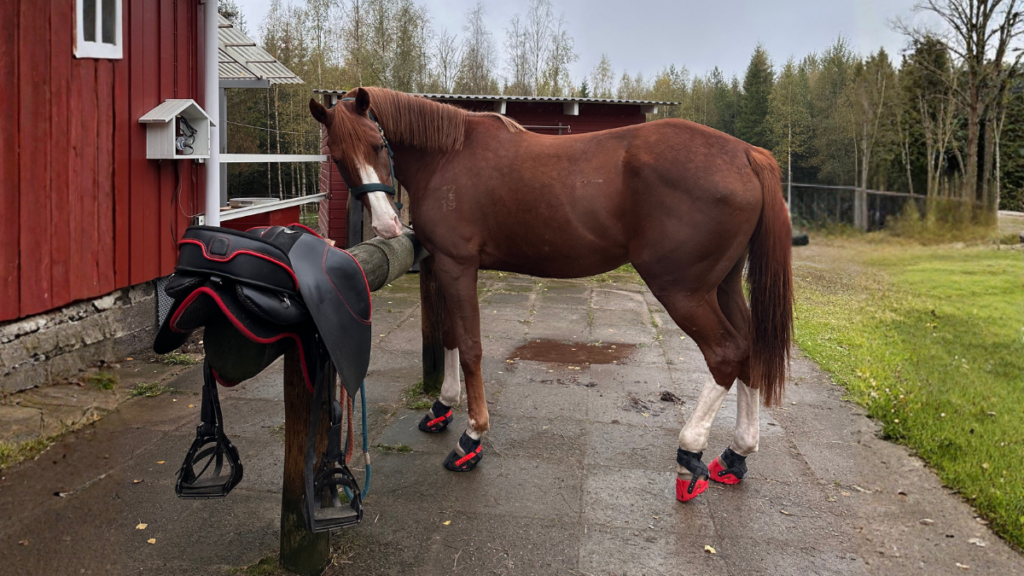
You might have heard us say that Flex Boots are designed for horses whose hooves are trimmed anatomically correctly. But what does that mean? Some think that it means that Flex Boots only fit perfect hooves, but that’s not the case at all. But how the hooves are trimmed does matter, and in this blog post we talk about how a trim affects the boot fit – and show you what can be achieved with just one trim, when done correctly.
What is an anatomically correct trim?
Although all horses have the same anatomical parts in the foot, those parts can vary in shape, size and condition quite a lot. For best results and to promote greater hoof health, each horse should be trimmed according to its individual needs, and in a way that encourages healthier hoof development.
- Toe should be kept short
- Hoof wall should follow the shape of the sole
- Heels need to be balanced and in their correct place in relation to the frog
- Bars should be trimmed to the level of the sole
- Frog should be fairly tidy but not overly trimmed
When the basic barefoot trimming principles are followed, and the trim is combined with the correct diet, living environment and exercise, the hooves will start to improve.
How a trim affects the boot fit
Sometimes the hooves may have serious problems that cannot be fixed straight away, and they require multiple trims in order to see improvements. These are the horses that often require hoof protection even for turnout, as their feet are sore. In these situations, the trim should still be the primary tool used to improve the hoof condition. Flex Boots (normally with pads for extra cushioning) can be used to make the horse more comfortable, but the owner needs to be aware that if the hooves are compromised, the boots may not fit in an ideal way, and this will affect how well they stay on.
But, there are many cases where all it takes is one skilled trim that follows the horse’s anatomy, to make the horse more comfortable and enable it to move in a correct way. This also results in boots fitting the hooves better. Remember – we do not trim the hooves for the sake of the boots fitting, but we trim them for the benefit of the horse. Boots fitting well is an added bonus.
Hoof before a trim
Here is an example of one such hoof, and it shows really well how a trim affects the boot fit. Here we show you the hoof before a trim, and show you how badly the boot fits the hoof. There’s no way this boot would stay on, or function in a proper way. A hoof like this is also not good for the horse: the toe is too long, and the heels are under-run. You can see that the hoof wall is chipping because it’s too long.


You can see above that the hoof is falling out from the back of the boot and the boot shell seems way too small for this hoof. If you tried to close the TPU gaiter, it would not sit neatly against the leg, and the pastern straps would probably not reach to attach in the front.
Hoof after a trim
Here is the same hoof after just one trim. Note how much healthier the hoof shape is: toe is shorter, heels are further back, and the wall is the correct height, which means that it’s much more unlikely to chip or crack.


Above is the hoof in the exact same boot size as in the before-trim photo. You can see that every part of the boot fits properly now: the entire hoof is within the boot shell, the top edge of the boot shell follows the coronet band nicely, and the TPU gaiter and straps fit this hoof well.
So if you’ve asked the question of “How a trim affects the boot fit”, the above is proof that it affects it a lot! The better you take care of your horse’s hooves, the better Flex Boots will also fit. And most importantly: your horse will reap the biggest benefits!