Mud is unavoidable for many equestrians at this time of year. It’s not just annoying and messy – it can seriously prohibit your horse’s exercise routine.
We get frequent questions about whether horse riding in mud is possible with Flex Boots, so in this blog post we explore this topic, and riding in mud in general, in more detail.

What are your expectations regarding riding your horse in mud?
Have you ever had to walk through mud? No matter how thin the layer of mud, you know that staying upright on a muddy surface is much harder than on dry ground. Now, imagine carrying a toddler (one that is moving about) on your back whilst walking in that mud. Then, that toddler will ask you to jog in the mud, or worse yet, they want you to sprint through it whilst still carrying them. Could you do it? Probably not.
This is very similar to how your horse feels when walking in mud. And this is why we always advise people to SLOW DOWN on muddy areas, allowing the horse to dictate the speed that they are comfortable with. This goes for any horse, whether they’re barefoot, wearing hoof boots, or even if they are shod.

Is horse riding in mud detrimental to your horse?
Horse riding in mud, especially deep mud, can cause injuries such as pulled tendons and overreach injuries. So ask yourself, is it absolutely necessary to go at a fast pace in muddy conditions? Or would it be wiser and kinder to let the horse go slow, find its footings and let the horse navigate the muddy parts? They are, after all, pretty good at figuring out where the best route for them is.
This is pretty easy to do when talking about pleasure rides and trail riding. Most of the time, you can take an alternative route, slow down, or wait for the ground to dry up a bit so that it’s safer to ride on.
But, because horse welfare always comes first for us, we’d go as far as saying that this same thinking should be applied to competitions too. If a competition ground is muddy and very slippery, it’s better to miss a competition or two, than to risk injury to your horse. After all, the horse doesn’t care about competing, winning or losing. That is purely a human endeavour.

Common questions about Flex Boots and mud
Here are the most common questions about horse riding in mud with Flex Boots on, and our answers to them.
- Can I ride in mud with Flex Boots?
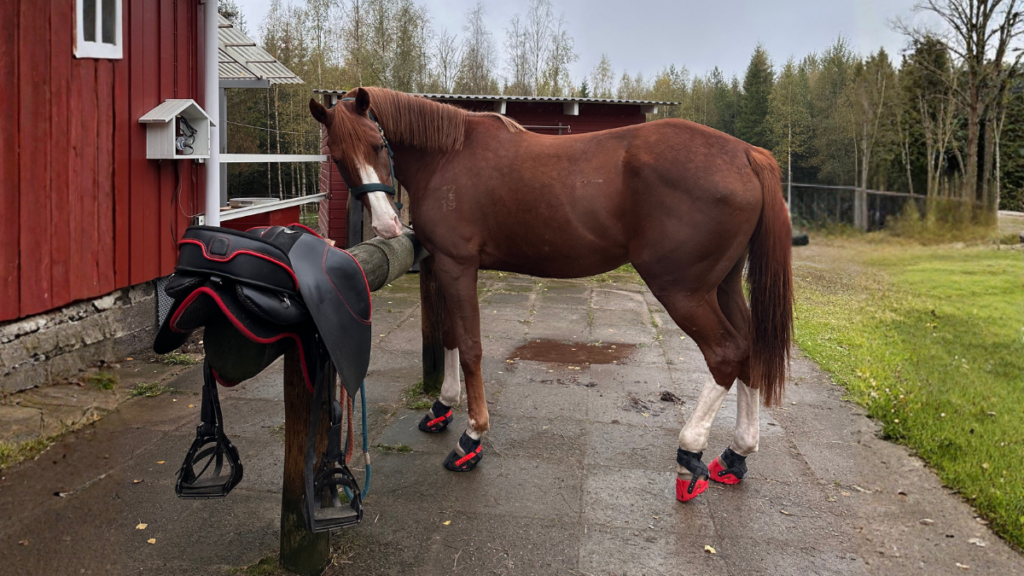
Yes you can. Flex Boots do not absorb water, so they won’t become soggy or heavy, no matter how wet or muddy your riding conditions are. But – as mentioned above, Flex Boots are not a miracle solution that will allow you to go at any speed on mud.
- Will Flex Boots provide good traction on mud?
Whilst Flex Boots won’t make the horse more susceptible to slipping in mud, they also will not provide noticeably improved traction on mud. So whether or not you wear hoof boots when horse riding on mud, you need to be careful and let the horse to go at a pace that they find comfortable.
- Can I use the ice studs to help with traction on mud?
The Flex ice studs are designed to improve traction on ice, where they bite into the icy surface. The studs, when applied to the boots, are only approximately 5mm (less than ¼”) long. This means that in order for them to help with muddy conditions, the thickness of the mud would need to be less than this, so that the studs could bite into the solid ground underneath the mud.
That being said, we do know of customers who have used the ice studs and say that they have helped with traction in these situations. So it all depends on the individual ground conditions that you have, really.
- Can I attach normal studs to Flex Boots?
Because Flex Boots are soft and flexible, you cannot attach larger studs to the boots – they would break the boot material and fall out very quickly.

In summary, mud poses challenges when it comes to horse riding, but the key to horse riding in mud safely is to let the horse dictate the pace, allow them to find their footing and their preferred route through muddy areas, and remember that horse welfare is more important than our human desire to go fast or compete. Dryer weather is bound to return eventually, so until then let’s all take is nice and slow if necessary.