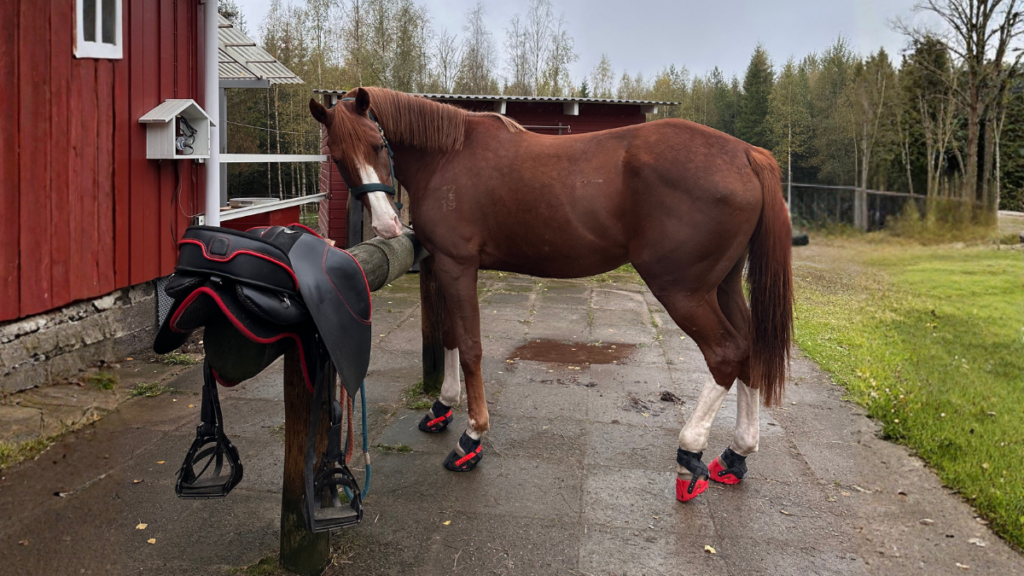
People often ask if they need to use pads in their Flex Boots, so this blog post is all about when and why to use pads in hoof boots.

Pads in hoof boots can help foot sore horses
Often, you don’t have to use pads in Flex Boots, because the insole design already acts as a kind of air cushion; it’s very effective in providing shock absorption on its own and is sufficient for most horses. However, some horses need additional protection, for example, if they have very thin soles or you ride on very stony roads. In these situations, pads can be beneficial. In general, if your horse is showing sings of not being entirely sound with just Flex Boots on, pads can provide the additional support that your horse needs.
On horses with extremely compromised hooves, you can even add two pads to increase the cushioning even further. But note that if you do this, you will probably need a size or two sizes larger boots.

Pads in hoof boots can help with the boot fit
If the boots are slightly too big, or if there’s a little bit of extra space at the sides or rear of the boot, pads can help improve the boot fit. FlexPads are relatively soft, and they mould into the insole and the horse’s sole to create a seal between the two, helping the boots stay put. When the pad compresses under the hoof, the uncompressed pad material on the sides of the boot helps fill out the extra space.

What’s the difference between the yellow and red FlexPads?
The yellow FlexPads are softer than the red ones. Yellow pads are ideal for horses that need additional cushioning for their hooves, for example as part of laminitis rehab, very thin soles, or if the boots are slightly too big, adding the yellow pads can make the fit just right.

Red FlexPads are firmer, and they provide more protection, which may be needed if the horse has thin soles or you ride on stony terrain. If the soles are thin it’s best to experiment with both pads and see which ones the horse prefers.

Both yellow and red pads will last longer if they are washed in warm water after use and dried somewhere warm – this helps the EVA foam plump up again.
How long will the pads last?
The pads’ longevity depends on several different things, such as the trim technique and frequency, and how balanced the hooves and horse in general is. Our FlexPads are softer than many other pads on the market, and that is for a good reason: their purpose is to provide cushioning and protection for the horse’s hooves without prohibiting the hoof function. They are not meant to compensate for the lack of adequate hoof care. If the horse’s hooves are not trimmed properly, FlexPads (and Flex Boots too!) will wear out quicker than if the hooves are kept in their ideal shape and size with a small weekly maintenance trim.
Because the pad material is softer, you will see signs of wear in the pads after the first uses, and this is normal. It doesn’t mean the pads need replacing straight away. FlexPads are supposed to mould to the insole and the horse’s sole, so that they squish down where there’s lots of pressure, and stay plump where there is less pressure. This enables the pads to provide support exactly where the horse needs it, whilst the horse remains sure footed.
Are your pads wearing out unevenly?
If you notice that the pads wear out in one specific part much quicker than elsewhere, this indicates that there’s an issue. It could be one of the following:
- The horse is moving in an imbalanced way, or the hooves are landing unevenly
- Hoof wall might be too long due to infrequent trimming
- Heel may be too high
- There might be sharp edges on the hoof wall
When this happens, we see it as valuable information that allows the owner to investigate the cause of the unbalanced wear pattern.
Here is an example of pads used approximately 25 times. Although you can clearly see more wear on certain areas, these pads are still completely usable. Judging by where the pads are worn, we can deduct that either the horse lands more heavily on the lateral (outer) side of the hooves (which can be a conformation issue), or the lateral (outside) heels are too high. We can also see that the bars are slightly too high, based on excessive wear on that area.