Author : Alicia Harlov
Alicia Harlov is one of Flex Boots’ Equine Educators and Barefoot Trimming Specialists, where she creates video content as well as written articles pertinent to barefoot hoof health and soundness. Outside of Flex Boots, Alicia is a PHCP-certified hoofcare provider and program mentor who lives on the North Shore of Massachusetts, where she runs a hoof rehabilitation facility with a special focus on navicular horses. She pursues continuing education for hoofcare, equine nutrition and biomechanics at every opportunity, from sources around the world.
When a horse suddenly looks sore or lame, it’s completely natural to start asking questions. Is it coming from the feet? Is the issue higher up in the limb? How serious is it? Before jumping to conclusions, there’s a simple and practical step that can offer valuable insight: try a pair of hoof boots. Not just as a form of protection, but as a diagnostic tool that can help you better understand where your horse’s discomfort may be coming from.

Why Hoof Boots Can Tell You So Much
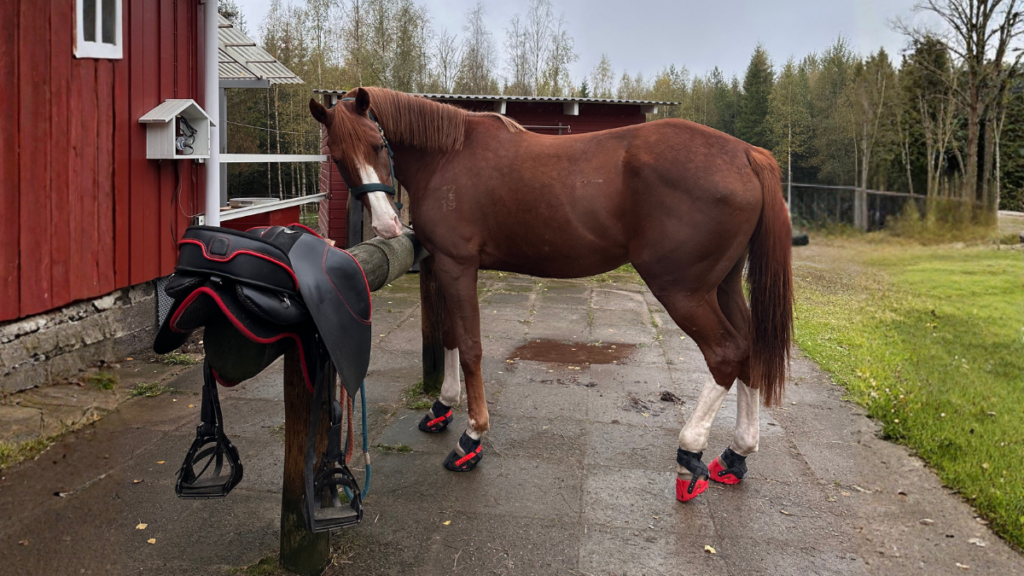
Hoof boots provide temporary protection to the hoof itself, extra cushioning for the sole and frog, and support to the structures inside the hoof. When you apply that protection and observe how the horse responds, you’re able to implement your own simple diagnostic test. You’re asking: “If I make the hoof more comfortable… does the horse move better?”
A horse that is more sound with simply adding a bit of support to the foot could likely have primary discomfort coming from the hoof. If boots do not resolve any discomfort at all, it is worth it to look elsewhere for causes of pain.

Scenario 1: Significant Improvement in Boots
Your horse is lame, hobbling around on hard, rocky terrain. You pull out a pair of boots, and try them on. Your horse walks off confidently, fully extending their limbs, and is able to navigate their environment comfortably again.
If your horse shows a clear improvement in comfort or soundness once hoof boots are applied – especially on firm, rocky, or uneven ground – that’s a strong indication the issue is likely coming from the hoof itself. This type of response often points to structures that are struggling to handle concussion or deal with surfaces they meet, such as thin or sensitive soles, weak or underdeveloped frogs, or bruising within the hoof capsule. In some cases, it may also reflect early or chronic laminitic changes, or simply a hoof that doesn’t have the protection it needs for the environment it’s being asked to work in, whether due to a trim not suitable for the horse, or weak structures due to a diet or metabolic issue. When a horse becomes noticeably more comfortable in boots, it suggests that the hoof isn’t currently coping well with the forces being placed on it or what is being asked of it. By adding boots, and, when needed, pads, you’re helping to reduce concussion, provide support to internal structures, and create a more comfortable landing surface under each and every step. This added protection allows the horse to move more freely and confidently while giving the hoof time and support to strengthen and improve. It also tells you an important piece of information – the hoof is what needs help, and you can use boots for comfort in the meantime, and focus on a hoof rehabilitation plan to help improve things over time.


Scenario 2: Partial Improvement
What if you try hoof boots and your horse clearly looks more comfortable, but not completely sound? Maybe the stride is a little freer, the hesitation is reduced, but something still isn’t quite right. This can be a common finding when putting boots on a horse dealing with lameness issues, and it IS important information. It tells you you’re on the right track with focusing on the feet, but you may not be providing quite enough support yet. This is where adding pads inside the boots can make a significant difference.
Pads allow you to fine-tune how much cushioning and support the hoof is receiving. By experimenting with different thicknesses and densities, ranging from softer, more forgiving materials to firmer ones, you can adjust what kind of support the hoof has and how challenging the ground plane becomes for them. Sometimes a horse that is only “a bit better” in boots alone will become noticeably more comfortable once the right pad is added. You may see longer, more confident strides, less hesitation on firm surfaces, and an overall increase in willingness to move forward.

This kind of response is incredibly useful to see. It reinforces that the discomfort is still coming from within the hoof, but that the hoof needs additional support or stimulation. In many cases, the horse benefits from increased sole protection, more consistent frog engagement, or improved shock absorption. Pads essentially allow you to customize the level of comfort, helping bridge the gap between just a little extra material under the hoof, and more targeted support while the hoof continues to strengthen and adapt.
Scenario 3: No Improvement in Boots
If your horse shows no change at all when wearing hoof boots, that’s important to note as well. When added cushioning and protection at the hoof level don’t improve comfort or movement, it suggests that the primary source of discomfort may not be within the hoof. Instead, the issue may be originating higher up the limb, where boots play less of a role influencing the underlying problem.
In these cases, you may be looking at factors such as joint discomfort, muscle soreness, back pain, or other compensation patterns that have developed over time. Restrictions in the shoulder or upper limb can also affect how a horse moves, often creating a gait that appears footsore or cautious, even though the feet themselves are not the root cause. Because hoof boots primarily reduce concussion and support structures within the hoof, they may not significantly change movement if the pain is coming from elsewhere in the body.
When there’s no improvement in boots, it’s helpful to broaden your perspective and investigate above the hoof. This might mean working with a veterinarian, bodyworker, or other professional to assess the horse more holistically. Rather than being a dead end, this response actually helps rule out hoof-related causes and guides you toward the next step in understanding and addressing your horse’s discomfort.

Scenario 4: Boots or Pads Make It Worse
This is a big one, and can sometimes be confusing for owners dealing with a lame horse. If your horse actually becomes more uncomfortable when wearing hoof boots, especially when soft pads are added, that response can offer some of the most important clues of all. While it might feel counterintuitive, worsening comfort in boots can suggest that the issue isn’t simply about needing more cushioning, it may point toward problems involving soft tissue structures or stability within the limb.
Soft pads, in particular, introduce a small amount of movement or “give” under the hoof. For many hoof-related conditions, this is beneficial, since it allows extra cushioning, helps distribute load more evenly, and can improve overall comfort. However, for horses dealing with soft tissue injuries, ligament strain, or instability higher up the limb, that added movement can actually make things feel less secure, and force the ligaments and tendons to overwork to stabilize the joints and limb. Instead of relief, the horse may feel painful from that lack of stability, leading to shorter strides, increased hesitation, or a noticeable worsening of lameness.
When you see this kind of response, it’s valuable feedback. It suggests that the horse may need more stability and firm surfaces rather than more cushioning, and that the source of discomfort could lie beyond the hoof capsule itself.
Another instance where boots may make a horse “more lame” is an upper body issue that is using the hoof to “compensate.” Some issues higher up in the body can become worse when the specific compensatory balance of the hoof is interrupted. These horses, in a lameness evaluation, may also become more lame when their hoof is numbed with a nerve block. Without their normal compensatory hoof balance and movement, the horse feels less stable and more painful.
In these situations, it’s important to pause and avoid continuing to experiment blindly. Instead, this is the time to step back and investigate further, ideally with the support of a veterinarian or experienced hoof care professional, so you can better understand what structures are involved and choose the most appropriate path forward.

The Takeaway
Hoof boots aren’t just a tool for riding or rehab, they can be a way to gather information, too. By observing how your horse responds, you can start to answer a critical question: “Is this coming from the hoof… or somewhere else?”
When a horse looks sore:
- Try hoof boots on level ground, where footing or uneven surfaces don’t confuse results
- Observe any change in comfort or movement
- Experiment with pads if needed
- Use the response to guide your next steps
This approach is simple, non-invasive, and incredibly informative. Every horse is different, and each case is unique, but with this simple step, we can learn to listen and observe our horses, and in turn, help them with their road to soundness.